Insight Assurance’s Dillard Trapp and Agency’s Tyler Carbone walk through the new CR26 vocabulary, what Classes A to D actually measure, the dates to plan around, and who owns each step on your way to FedRAMP certification. The session closes with a live Q&A on SOC 2 Type II and Class A, and on FedRAMP versus CMMC.
What you’ll learn about FedRAMP CR26
- The new vocabulary. FedRAMP now certifies, and federal agencies authorize. The security decision record (SDR) takes the place of the long SSP narrative, and ongoing certification reporting takes the place of continuous monitoring.
- What a Class measures. How much information FedRAMP collects about your offering and how often it is refreshed, rather than how secure your service is.
- How to choose a Class. Why the federal agencies you support should set your target, and where Class A fits if none has.
- Evidence that proves outcomes. Why 20x looks for automated tests showing a control works, not just that a setting is turned on.
- The dates to plan around. December 7 for VDR and VER, January 1 for the CR26 rules, February 1 for the end of the grace period, and the tentative June 11, 2027 cutoff for new Rev5 submissions.
- Who owns what. You own and submit the package. Insight Assurance performs the independent assessment. FedRAMP certifies, and federal agencies authorize.
Speakers
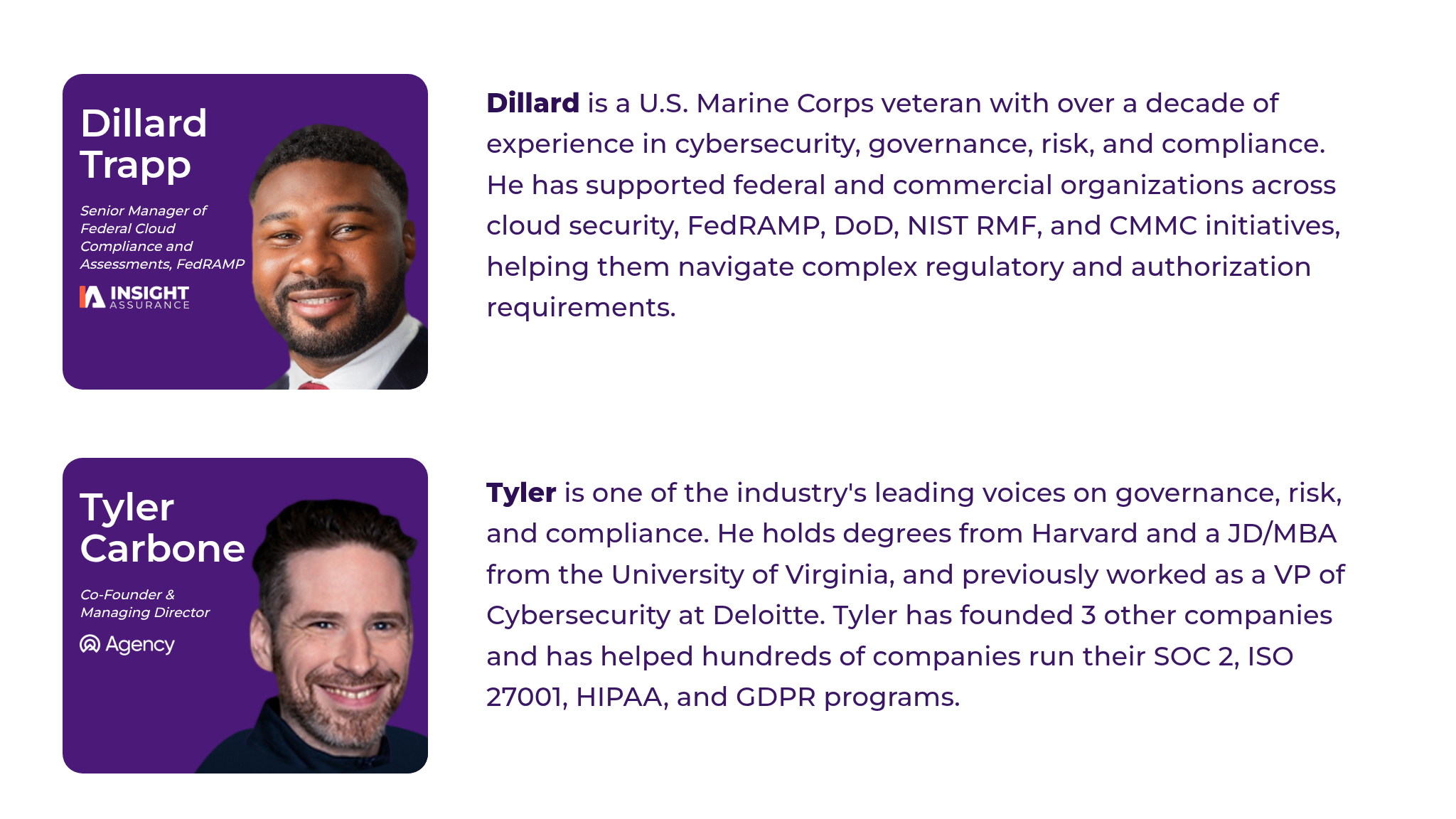
Dillard Trapp, Senior Manager of Federal Cloud Compliance and Assessments, FedRAMP, Insight Assurance, and Tyler Carbone, Co-Founder and Managing Director, Agency.
Key takeaways: from FedRAMP impact levels to Classes A to D
1. FedRAMP certifies. Federal agencies authorize.
Dillard explained that FedRAMP no longer uses “authorization” for its own decision. FedRAMP certifies a system and gathers the information that agencies and other authorizing bodies then use to make their own authorization decisions. The assessor term has shifted too, from 3PAO to FedRAMP recognized assessor.
2. Classes set the level of scrutiny, not a security grade.
A Class describes your offering: how much information FedRAMP collects, how often it is refreshed, and how many checks support it. Dillard said the mapping to impact levels is rough and not one for one, but loosely low tracks to B, moderate to C and high to D. Class A has no real legacy equivalent and serves as the starting point. Today A, B and C are open, and Class D is expected in 2027.
“The class system to me is not a security grade.”
Dillard Trapp, Insight Assurance
3. Let your federal agencies set your target.
Both speakers came back to this. Tyler suggested asking the agency what it required under the old framework if it isn’t sure yet what it will expect under 20x, and noted that some agencies allow you to phase in one Class by a set date and a higher one later. In Tyler’s words, “If a federal agency is going to specify a level, we almost always recommend the lowest class that fits.” Where no agency has specified a level, Tyler said Agency is starting to recommend Class A as the place to start, and advised against investing in the higher Classes without a specific agency in mind.
“At the end of the day, the agencies are going to dictate what they’re going to require.”
Dillard Trapp, Insight Assurance
4. 20x tests outcomes, not settings.
Tyler explained that 20x goes beyond automated evidence collection. Showing that a firewall rule exists is one thing. Testing on a recurring basis that it still blocks unauthorized traffic is what the assessor looks to verify. The number of automated validations per KSI rises with each Class, up to four or more at Class D. Dillard described his side: he checks that each test is valid and accurate, confirms the outcome matches what is expected, and repeats that as many times as FedRAMP requires for the Class.
“The rule existing is not the same as the action being taken.”
Dillard Trapp, Insight Assurance
5. Your SOC 2 Type II can be a foundation for Class A.
Dillard listed the short prerequisite list for Class A: a SOC 2 Type II from within the past year, or a FedRAMP Rev5 Ready, Rev5 or GovRAMP assessment. Class A then adds 7 KSIs and a few hard deliverables, such as a Marketplace listing and a certification package overview. In the Q&A, Tyler said the underlying security aligns closely with SOC 2, but the assessment looks for evidence that controls operate effectively in an automated way.
“So the actual security controls are relatively similar. The content of the audit is gonna be pretty different.”
Tyler Carbone, Agency
6. Know the dates.
Dillard walked through the timeline, noting that some dates are tentative and could change:
- December 7: VDR and VER take effect (confirmed during the session).
- January 1: the CR26 rules become mandatory for 20x and active certifications.
- February 1: the grace period ends. Offerings not following the rules lose certification, and FedRAMP is not planning to grant extensions.
- June 11, 2027: tentatively, no new Rev5 submissions accepted.
- December 31, 2028: the latest date the current rules expire.
7. Keep your evidence fresh, and plan your submission window.
Dillard explained three windows. Your package evidence must be verified, validated and current within 7 days before you submit. You have 3 months after your independent assessment to submit. Past that, expect a refresh similar to a quarterly review, and past 9 months from the initial assessment, a full reassessment.
8. The package is yours, and the assessment is independent.
Dillard noted that assessors no longer submit packages and FedRAMP no longer hosts them. It is up to you, the cloud service provider, to submit. Tyler added that your organization stays accountable for the package and for the ongoing automated program behind it. On independence, Dillard was direct:
“Preparation and assessment sit with different parties on purpose. If I help prepare, I can’t independently assess, and that’s just ultimately protecting the value of the certification for agencies that rely on it for their own authorization decisions.”
Dillard Trapp, Insight Assurance
“I can’t tell you how to fix things that then I’m gonna grade.”
Dillard Trapp, Insight Assurance
9. Expect the rules to keep moving.
Asked when the final changes will arrive, Dillard said the process will likely evolve over the next 1.5 to 2 years, and a recent request for comment pushed back the phase for Class D and signaled new Classes next year. His advice is to follow what the FedRAMP PMO publishes on fedramp.gov and the rule updates in its GitHub repository. Tyler’s advice: focus on the baseline security controls your agency expects, which tend to stay constant even as the framework changes.
Who does what on the path to certification
- You: own your controls, your trust center and your certification package, and submit to FedRAMP.
- Agency: an MSSP that works mainly with high growth companies.
- Insight Assurance: performs the independent assessment.
- FedRAMP: makes the certification decision. Federal agencies make their own authorization decisions.
FedRAMP CR26 and classes: frequently asked questions
What does CR26 change in FedRAMP’s vocabulary?
FedRAMP now certifies systems, and federal agencies authorize them. The security decision record (SDR) documents your decisions on the KSIs and rules, replacing the long SSP narrative. Continuous monitoring is replaced by ongoing certification, a report to agencies and other stakeholders every 3 months. Assessors are now called FedRAMP recognized assessors rather than 3PAOs.
How do Classes A to D compare to low, moderate and high?
Not one for one. As discussed in the session, the mapping loosely tracks low to B, moderate to C and high to D. Class A has no real legacy equivalent and acts as the starting point. A Class describes how much information FedRAMP collects about your offering and how often it is refreshed, not how secure the service is.
Do I still need an agency sponsor?
No. The requirement for a federal agency sponsor before certification has been lifted, so you can begin the FedRAMP certification process without one. Tyler noted a sponsor is still helpful, and his advice is generally not to pursue certification without a specific agency in mind, so you can confirm which Class it expects.
Can a SOC 2 Type II report support Class A?
Yes, as one of the prerequisites. Dillard listed a SOC 2 Type II from within the past year, or a FedRAMP Rev5 Ready, Rev5 or GovRAMP assessment. Class A then adds 7 KSIs and deliverables such as a Marketplace listing. Tyler explained that the security controls overlap closely with SOC 2, but the assessment looks at whether those controls operate effectively in an automated way, so expect different questions and different evidence.
How recent does my evidence need to be, and who submits the package?
Your package evidence must be verified, validated and current within 7 days before submission. You have 3 months after your independent assessment to submit, and anything older than 9 months needs a full reassessment. You, the cloud service provider, submit the package. Your assessor completes the assessment, and FedRAMP reviews what you submit.
What are VDR and VER, and when do they take effect?
VDR and VER take effect December 7, as confirmed during the session. Dillard described them as replacing the old POA&M spreadsheet model with more persistent detection and validation across your whole system, with VER focused on scoring that is published in a machine readable format. Tyler added that the requirement is broader than before and depends on your organization. It may call for things like threat intelligence and monitoring of third party and supply chain risk.
Planning an independent FedRAMP 20x assessment?
Talk with our team about the scope of an independent assessment for the Class your federal agencies expect.