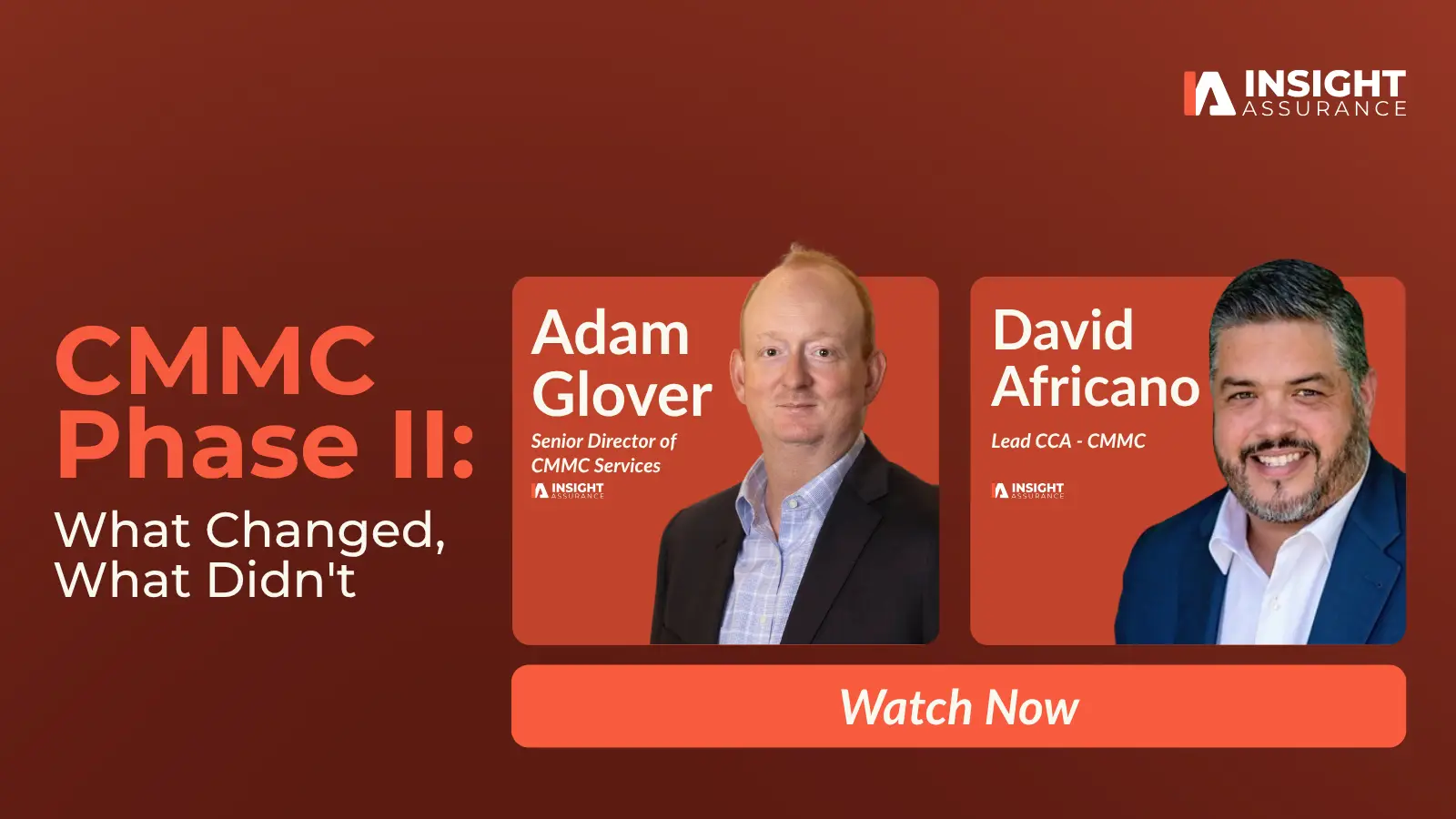
Insight Assurance recently hosted a webinar on Cybersecurity Maturity Model Certification (CMMC) readiness for organizations that handle controlled unclassified information (CUI). CMMC can feel straightforward when you read the model. The friction usually shows up later, when teams try to confirm what is in scope, align documentation to the actual environment, and collect evidence that will hold up during assessment review.
This session brought together perspectives from assessment, readiness, and automation to talk through where projects stall, what tends to create rework, and how to keep the path to assessment manageable.
Panelists included:
- Adam Glover, Director of Audit Services, Insight Assurance.
- Justin Graham, Co-Founder, Steadfast Partners.
- Rob Gutierrez, Senior Cybersecurity and Compliance Manager, SecureFrame.
Here, we’ll highlight the key points from the session, including scope and evidence discipline, careful handling of FedRAMP-related considerations, and how automation can support repeatable readiness work.
The First Bottleneck Is Usually Scope, Not Controls
Justin Graham opened with a point many teams learn after work is already underway: It is difficult to build a reliable plan until the scope is clear. When CUI boundaries are uncertain, everything downstream gets heavier. The system security plan (SSP) becomes harder to write accurately, evidence collection becomes inconsistent, and remediation sequencing becomes less predictable.
The panel noted that scope surprises often look small at first, but they can ripple. A single “where does CUI actually live” question can expand into access paths, inherited permissions, data flow assumptions, and systems that touch CUI indirectly through integrations or shared workflows.
FedRAMP Experience Helps, But It Can Create False Confidence
Adam Glover addressed a misconception he sees regularly. Organizations with FedRAMP experience sometimes assume CMMC will be easy because the control concepts feel familiar. In practice, CMMC still requires careful validation of what is in scope, which responsibilities sit with the organization versus providers, and what evidence is needed to substantiate those responsibilities.
As Glover put it, “a lot of clients think they know FedRAMP, so by default they know CMMC,” but that “couldn’t be further from the truth.” The panel’s point was not that overlap is meaningless. It is that overlap does not eliminate CMMC-specific scoping, documentation, and evidence work.
Clarity Around Documentation Reduces Assessment Friction
In the Q&A, the panel returned to a practical documentation issue. When organizations maintain multiple frameworks, it is tempting to cross-link everything across SSPs and procedures. That can slow reviews and create confusion for assessors. Glover noted that linking CMMC SSPs to FedRAMP documentation can make reviews “even more convoluted,” especially when readers have to jump between documents to confirm what applies to the CMMC scope
Where Automation Fits
Rob Gutierrez discussed automation as a way to keep readiness work organized and repeatable. The benefit is less time spent chasing artifacts across systems and more consistency in how evidence gets captured and maintained over time. When workflows, owners, and evidence locations are clear, teams spend less effort rebuilding context each time a request comes in.
Key Takeaways
- Scope clarity drives SSP accuracy, evidence quality, and timeline stability.
- Framework familiarity does not replace CMMC-specific validation work.
- Clear documentation reduces confusion during review.
- Automation helps most when it supports repeatable evidence workflows.
Want to learn more? Watch the full webinar to hear the full discussion, or connect with Insight Assurance to clarify assessment expectations and evidence needs through an independent audit lens.